Tethered vs Untethered EV Chargers for Holiday Lets (2026)

Written by Billy Karidis, Co-founder, GuestCharge
Last updated: 9 June 2026 · 6 min read
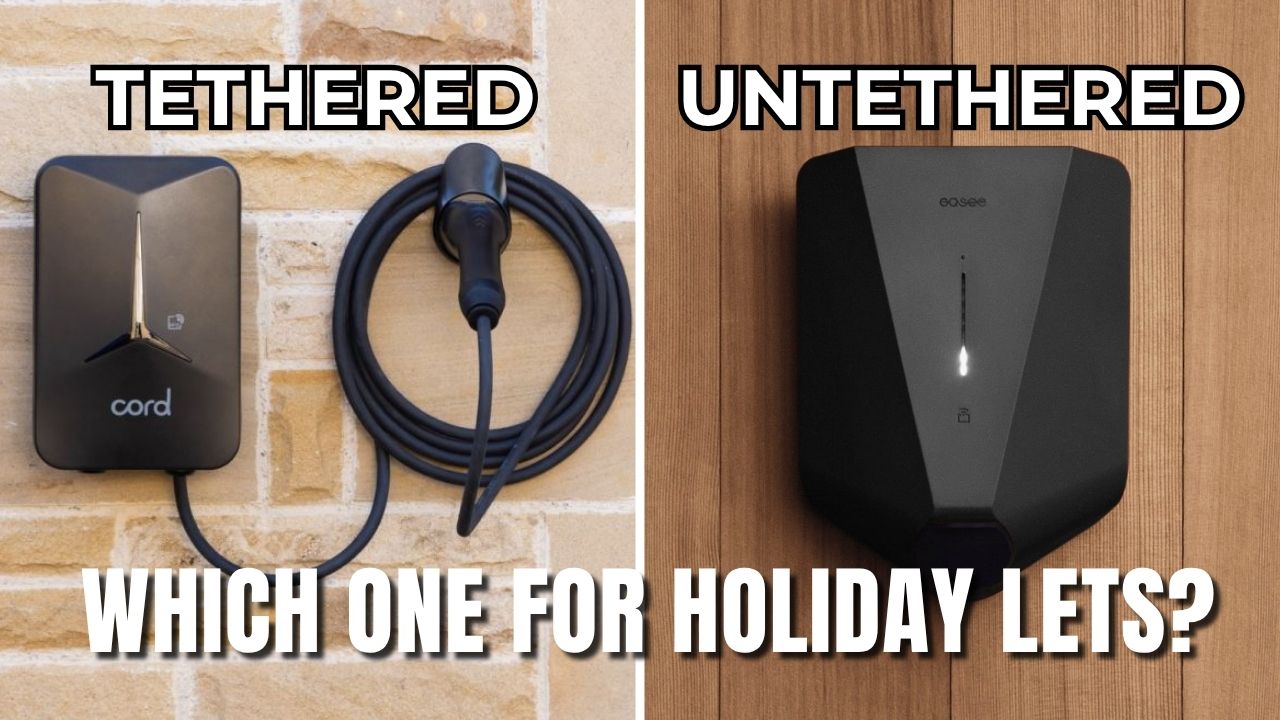
Quick answer: A tethered charger has a cable permanently attached, so a guest just grabs it and plugs in. An untethered charger is a socket, and the guest supplies their own cable. Both charge at exactly the same speed; the choice is about convenience, durability and who brings the cable. For a holiday let, tethered is usually the better guest experience (nothing for them to find or carry), while untethered is tidier, easier to replace if damaged, and avoids a cable hanging exposed at an unattended property. Neither is "better" outright. It depends on your property and your guests.
If you're putting an EV charger at a holiday let, one of the first choices is tethered or untethered. Most guides answer this for a homeowner charging the same car every day, which is a different situation from a rental used by a rotating set of guests in all sorts of vehicles. This guide looks at the decision specifically through a holiday-let lens.
One thing worth saying up front: we don't sell chargers. GuestCharge is the billing layer that works on top of whatever OCPP-compatible charger you choose, so we've no reason to push you towards one type or one brand. A lot of the advice you'll find on this question comes from companies that make a particular charger, which shapes what they recommend. We genuinely don't mind which you pick, so here's the impartial version.
The difference, plainly
A tethered charger has the charging cable permanently attached to the unit. It coils onto a holder when not in use. To charge, you pull the cable out and plug it into the car. Cables are typically 5 to 7.5 metres long.
An untethered charger (sometimes called socketed) is just a Type 2 socket on the wall. The user plugs their own separate cable into the charger at one end and the car at the other, then unplugs and stores it afterwards.
The single most important myth to dispel: they charge at identical speeds. Tethered versus untethered makes no difference to power, efficiency, or how fast a car charges. On a standard UK single-phase supply both deliver around 7kW. The choice is purely about usability, durability and flexibility, not performance.
What changes when it's a holiday let
For a homeowner, this is mostly a personal convenience call. For a holiday let, three things make the decision different, and they're the things the generic guides don't consider.
Your "user" is a different guest every few days, in an unpredictable car. You don't know in advance what vehicle a guest will arrive in or whether they travel with their own charging cable. Most modern EVs use a Type 2 connector and many owners carry a cable, but not all do, and a guest who turns up without one can't use an untethered charger. A tethered cable removes that uncertainty: it's there, it works, they plug in.
The charger is unattended and outdoors all year. At a home, the owner looks after the kit. At a let, a permanently-attached tethered cable sits exposed to weather, wear and the occasional careless guest, season after season, with nobody keeping an eye on it. An untethered socket has no exposed cable to weather or damage, which can mean less wear over time, though it does rely on each guest having a cable to plug in.
You're managing it remotely. If a tethered cable gets damaged, it can be replaced, but it's more involved than swapping a cable on an untethered unit: depending on the model, it means fitting a bare-ended replacement lead (a job for a qualified electrician) or, on some cheaper units, replacing the whole charger. With an untethered charger, a worn or damaged cable is just a new cable the guest or you can swap in. That's a point in untethered's favour for a hands-off rental.
Tethered: the case for a holiday let
- Best guest experience. Nothing for the guest to find, carry or figure out. They arrive, plug in, done. For a guest who's never used your property before, that simplicity matters and shows up in reviews.
- Works for guests without a cable. You're not dependent on every guest travelling with their own Type 2 cable.
- Lower theft and loss risk for the cable. The cable is fixed to the unit, so it can't be borrowed and not returned.
The trade-offs: the cable is exposed to the elements and wear at an unattended property; you're locked to one connector type (fine for the Type 2 standard, but inflexible); and if the cable fails, replacing it is more involved than on an untethered unit (an electrician fitting a replacement lead, or on some cheaper models a new charger).
Untethered: the case for a holiday let
- Tidier and lower-wear. No cable permanently hanging on the wall, nothing exposed to weather between guests. The unit is smaller and neater, which photographs well on a listing.
- Easy, cheap to fix. A damaged or worn cable is simply swapped for a new one, with no electrician and no charger involved.
- Flexible and future-proof. Not tied to one cable length or connector, which helps as cars and guests vary.
The trade-offs: the guest must supply (and correctly connect) their own cable, so a guest without one is stuck; and it's marginally more faff for the guest, who has to plug in at both ends and store the cable after.
So which should you choose?
For most holiday lets, the deciding question is: how much do you want to remove friction for the guest versus minimise wear and maintenance for yourself?
- If you want the smoothest possible guest experience and to serve guests regardless of whether they carry a cable, tethered is usually the better fit. Most holiday-let owners lean this way, because a frustrated guest at an unfamiliar property is a review risk, and "just plug in" is hard to beat.
- If your priority is a tidy, low-maintenance, easily-repaired setup at an unattended property, and you're comfortable that most of your guests will have their own cable, untethered is a sensible, lower-wear choice.
There's no universally correct answer, which is rather the point. If it helps, a reasonable default for a typical holiday let is tethered for guest simplicity, switching to untethered if your property's exposure, tidiness or maintenance considerations outweigh that.
Whichever you choose, two things matter more for billing than the tethered/untethered question: the charger must be OCPP-compatible (so you can bill guests for what they use), and you'll want to think about MID-certified metering for compliant billing. We cover both in our guide to the best EV chargers for UK holiday lets.
The bottom line
Tethered and untethered chargers charge at the same speed, so this isn't a performance decision. For a holiday let, tethered usually wins on guest convenience and works for guests who don't carry a cable, while untethered wins on tidiness, lower wear at an unattended property, and cheaper cable replacement. Pick based on your guests and your property, not on what any hardware seller is steering you towards.
Once the charger's in, billing guests fairly for the electricity they use is the part we handle. GuestCharge works with whatever OCPP-compatible charger you've chosen, tethered or untethered, so you can decide on the hardware purely on its merits. See how it works.
Continue reading
7 min read
EV Charging for Small Businesses and Hospitality (2026)
Hotels, B&Bs, pubs and small venues can let guests charge and pay per kWh, without commercial charge-point software.
5 min read
Does Offering EV Charging Affect Your Holiday Let Insurance?
Adding a charger is a disclosure point: what to tell your insurer, the liability cover to confirm, and the records to keep.
13 min read
How to Start a Holiday Let in the UK (2026 Guide)
A step-by-step guide to property, planning, licensing, the post-FHL tax rules, mortgages, and the amenities that win bookings.
Sources
- Manufacturer and installer specifications for UK domestic EV chargers, 2026 (cable lengths, Type 2 connector standard, tethered/untethered configurations)
- Open Charge Alliance, OCPP protocol
Written by the founders of GuestCharge. We are hardware-agnostic and do not sell EV chargers, so this guidance is impartial. Confirm specifications and suitability with the charger manufacturer and a qualified installer before purchasing.